Tuesday, November 15, 2005

A Picture Share!

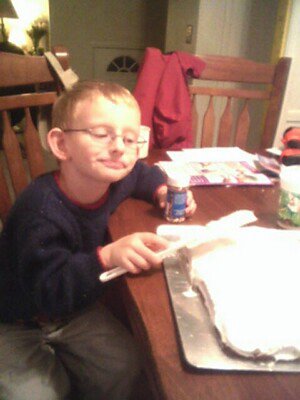
Alec frosts daddys cake too

A Picture Share!

Alec makes daddys birthday cake

Google Video Upload Program

Google Video Upload Program FAQ: "Google Video lets you search a growing archive of televised content -- everything from sports events to dinosaur documentaries to news programs. In addition to televised content, we'll also host video from anyone who wants to upload content to us. "

Like, anyone. Including you. Or me. Whoah.

Weird playback though; it's all ripped into a Flash player. Good resolution, tho - 720x480.

Monday, November 14, 2005

A Picture Share!

Alec is 3' 8" today! (finally got the measuring stick bolted up to the wall)

Saturday, November 12, 2005

Idea: encourage kansas to spend money on tourist friendly features like overlooks and twisty back roads.

Friday, November 11, 2005

Wired News: Scientists Offer Hydrogen Fix

Finally - people getting a clue about how to make Hydrogen: Use Nukes. Great quote follows to about the safety of a nuclear power plant.

Wired News: Scientists Offer Hydrogen Fix: "You can fly a 747 into a nuclear reactor and it's very bad for the 747 but it won't actually do anything to the meter-thick concrete around the reactor core,"

Thursday, November 10, 2005

Google Local for mobile

Google Local for mobile: "Google Local for mobile is a free download that lets you find local hangouts and businesses across town or across the country — right from your phone. "

And, it's a local app for the phone - no dinking with a crappy web browser!

Question: if a phone company has a service to pay for third party products do you have to pay phone taxes on those purchases?

To do : develop app for cell phone to post to blog and pod cast with itunes tag support

Wednesday, November 09, 2005

Scientific Methods Info


Since Kansas is refusing to teach the scientific method, I figure I'll start. Couple of posters:

Color poster

Simpler B&W


Now for some discussion on the issue

Why Inteligent Design is not scientific (From a comment on Slashdot. ):

Project: Prove that no intelligent being had a hand in the creation or evolution of life.

Can't be done - it's a textbook example of proving a negative - logically insoluble. The only way you can prove a negative is by empirical evidence - I don't *know* that we're not actually being held down by thousands of tiny invisible fairies flapping their wings, but I *do* know that things in a vacuum fall done at the same rate, and flapping wings can't help you fly in vacuum, so I consider this theory disproven, so empirically I can prove that no fairies meeting this description are causing the illusion of gravity.

[editors note: Philosopher Karl Popper cannonized this in his writing Science as Falsification with this statement: "[...] the criterion of the scientific status of a theory is its falsifiability, or refutability, or testability." ]

Intelligent Design has no such empirical test - the theory that we're being pulled down by tiny invisible fairies is in fact a scientific theory in a way that I.D. isn't, because I can design a test to disprove it. Go through enough iterations of my testing the theory, and modifying the theory to fit the new test (They're unbreathing fairies, with tiny 'lil rubberbands holding them down), and we'll find that eventually I have 'fairies' that look astonishingly like gravitons. Personally, Physics is easier than stubbornly staying with the fairies theory, but the nature of the scientific method means I will, after many iterations, home in on the same truths.


Continuing on:

Evolution is not a theory - it is a fact. It happens, it is observable. The *why* of evolution, or the mechanics of how it works, are still being investigated, and new facts and evidence are being added toward the various theories. By the way, in the scientific world, "theory" means "a statement of what are held to be the general laws, principles, or causes of something known or observed", as defined by the Oxford English Dictionary.


Others:

Nat has a good post on his blog with some fine quotes from the democratically elected members of the Kansas Board of Education. Remember these quotes come election time . . .

Witfits has a neat post from the Vatican

Tuesday, November 08, 2005

Alec telling us what he's learned in school

this is an audio post - click to play

My son, Alec, age 4, reviewing what he's learned in school. That's his Mom you hear in the background also. Posted via Audioblogger and my SprintPCS phone.

Sunday, November 06, 2005

How NOT to answer a test question

When asked to provide ways that a company may act socially responsible, it's not a good idea to quote Friedman in your 'short answer':

The Social Responsibility of Business is to Increase its Profits, by Milton Friedman: "[...] the use of the cloak of social responsibility, and the nonsense spoken in its name by influential and prestigious businessmen, does clearly harm the foundations of a free society"

We'll see what I got for a grade on this one by Wednesday...

Friday, November 04, 2005

Adding 'Safety' to Space Flight?

NASA made the best of a bad set of circumstances. They were using outdated technology, with little option to discard the bad technology. They had to make use of the shuttle because of political concerns - current plans by the Bush administration still call for over 25 more missions with the current shuttle! (Bell, 2004) If the shuttle were cancelled, there are many technically superior and more cost effective launch platforms available (ibid.).

The engineers at NASA looked at the statistics for space travel - it is an inherently risky business - and concluded that spending billions of dollars for escape hatches, ejection seats and more was not a worth while use of taxpayer money. The escape methods would only be of use for the few seconds that the shuttle would be within the atmosphere on liftoff and descent. Even the escape pole installed after the Challenger disaster is only useful when the orbiter is in a controlled glide above 20,000 feet - an unlikely scenario for a disaster( Halvorson, 2001). NASA shuttle program development manager Elric McHenry admits the escape pole would not be effective under most failure scenarios (ibid.). Political pressure to "do something now!" most likely led to the installation of this flawed escape tool. More effective systems that would protect the whole crew from a wide variety of failure modes require extensive reconstruction of the shuttle, cost over a billion dollars to install, and reduce the available payload, already low at 50,000 pounds (Halvorson, 2001). The decision was rational to meet the political pressures. However, from a true safety standpoint or a budgetary view, it was irrational - it adds little to crew safety and added a large sum to the cost of the shuttle. The decision to install the escape pole was a classic example of a satisficing decision - to obtain an outcome that is good enough, rather than excellent. It is a sad state that NASA, once the paragon of maximising actions now makes decisions like this to meet political pressures.

If I were in charge of NASA, I would have made a different decision - that the shuttle has outlived its' usefulness, and we should instead concentrate on newer technology, like a space plane, and use old, proven technology like big dumb rockets for package launches. However, the shuttle is a politically popular spacecraft, and is the symbol for the American space program. Replacing it with cold-war era missiles would not be a popular decision. Additionally, major US aerospace firms have a billion dollar a year vested interest in keeping the shuttle in place - Boeing, Rockwell, Lockheed-Martin, among others (Meyer, 2002).

The decision to add safety measures to the shuttle, along with the decision to keep the shuttle flying, should be revisited by NASA and the government. The four-billion dollar a year investment, along with the 30,000 employees that keep the shuttle running, could be better directed toward R&D. Ideas like maglev launch, nuclear engines, and the space elevator require major funding (Meyer, 2002). Funding that could come from the failed shuttle program.


References:
Bell, J. F. (02/19/2004). "Is The Shuttle Grounded Forever?" Space Daily website. Retrieved 11/04/2005 from http://www.spacedaily.com/news/shuttle-04d.html

Halvorson, T. (04/11/2001). "NASA Studies Advanced Shuttle Crew Escape Systems (Online)". Space.com website. Retrieved 11/04/2005 from http://www.space.com/news/spaceshuttles/shuttle_escape_systems_010410-1.html

Meyer, C. (11/01/2002). "Scrap the Shuttle Program (Online)". Space Daily website. Retrieved 11/04/2005 from http://www.spacedaily.com/news/shuttle-02p.html


How essential is manned spaceflight?

How essential is manned flight? That depends on your goal.

If your goals are strictly commercial and military - stuffing more black boxes in orbit to deliver movies, pr0n and 24 hour home shopping, or taking pictures of desert installations of weapons of mass destruction - then no. All of that can be done better, cheaper and faster by unmanned booster rockets. The US, with the largest space budget in the world, has fallen to less than a third of the world space launch market share (Meyer, 2002).

If your goals are more future minded - establishing humanity on more than one planet, to ensure future survival of the species - then yes, it is critical. We must learn how to move, survive and travel in space. We must learn how to build generation ships to send colony groups to nearby stars. We must create technologies to provide continuous acceleration with minimal mass. The human condition demands expansion and exploration.

An article published in the December, 2004 issue of The American Enterprise sums it up quite well:

"European cultures were vastly invigorated during the Renaissance by the discovery of the New World. Columbus, Vasco de Gama, and Magellan became heroes who defined the West for centuries. Cultures that pioneer seem to thrive, while those that stop pioneering often fester and degenerate. "Human beings either look out or they look down," said [Louis] Freedman [of the Planetary Society]" (Tucker, 2004)


Meyer, C (11/01/2002). "Scrap the Shuttle Program (online)". From Space Daily Website. Retrieved 11/04/2005 from http://www.spacedaily.com/news/shuttle-02p.html

Tucker, W. (12/2004). "The Sober Realities of Manned Space Flight (online)." The American Enterprise. Retrieved 11/04/2005 from http://www.taemag.com/issues/articleid.18295/article_detail.asp

A Picture Share!

Alec says "thanks for the card, gramma and grandpa!"