
Wednesday, May 23, 2007


Saturday, April 14, 2007
Archiving the Past

I found a box of reel-to-reel tapes in the garage - seems to be from 1956 through about 1959. I'm not sure who all is on it - mostly my grandfather and his children it appears, along with some mixed musical selections. It's all 1/4" two-track mono stuff; not the easiest to recover. I got a quote from a local recording studio of $1.00 per minute (!) to copy it over to CD. I thought I may be able to do a bit better job myself; or at least a *cheaper* job anyway.
I got to reading up on reel to reel formats and tapes and more; didn't seem like it would be too impossible. I found several very nice rigs on eBay - for $500 or more! Then I ran across this little consumer grade Sony rig for $70.00 shipped. Not bad - and it even works! Here's the first track I've snarffed off a tape. I think it's RKD Sr. speaking of one of his kids going on to first grade.
So, here's the setup for now - Mac laptop, Grado cans, Sony RTR, and a stack of odd tapes to clear out . . .

(Some people spend their Saturday nights going out to the bar; some going on a date; me? I copy tapes. AV Geek.)
Side note: It's interesting that I can play back 50 year old recordings without too much hassle, but I have video tapes from just ten years ago that are no longer supported - the players are no longer made! Technological innovation keeps on going, I guess . . .
Tuesday, April 10, 2007
RPN Engineering Calculator - for your PHONE
A real calculator using Reverse Polish Notation, scientific, statistic, financial, graphic analysis, blah blah blah. Free. For your cell phone. Wow.
Calc - Java Calculator: Scientific, Statistical, Financial,
Programmable, Graphing, RPN
Calc - Java Calculator: Scientific, Statistical, Financial,
Programmable, Graphing, RPN
Wednesday, April 04, 2007

Saturday, March 31, 2007

Thursday, March 22, 2007
Ham Radio Bits...
Carolina Windom Antenna
* http://www.hamuniverse.com/k4iwlnewwindom.html
Horizontal Wire Loop antennas (basically 2lambda, at least 0.10 lambda up)
* http://www.cebik.com/wire/horloop.html
Icom IC-718 transiever ($550)
* http://www.icomamerica.com/products/amateur/718/
* http://www.associatedradio.com/radios/icom/ic-718page.html
* http://www.eham.net/reviews/detail/947
Note - the no-code technician class has phone (voice) privileges on 10 meter (28.0 Mhz); and CW (morse code) on 80, 40, and 15 meters. To get the popular 20 meter band, or phone (voice) privs on lower bands, you need the new General class licence. 10 meters is dead right now - we are at the bottom of the sunspot cycle - but by 2011, it should be outstanding for DX skip. An E-W facing Windom antenna should do great on 10.
* http://www.arrl.org/FandES/field/regulations/Hambands_color.pdf
* http://www.hamuniverse.com/k4iwlnewwindom.html
Horizontal Wire Loop antennas (basically 2lambda, at least 0.10 lambda up)
* http://www.cebik.com/wire/horloop.html
Icom IC-718 transiever ($550)
* http://www.icomamerica.com/products/amateur/718/
* http://www.associatedradio.com/radios/icom/ic-718page.html
* http://www.eham.net/reviews/detail/947
Note - the no-code technician class has phone (voice) privileges on 10 meter (28.0 Mhz); and CW (morse code) on 80, 40, and 15 meters. To get the popular 20 meter band, or phone (voice) privs on lower bands, you need the new General class licence. 10 meters is dead right now - we are at the bottom of the sunspot cycle - but by 2011, it should be outstanding for DX skip. An E-W facing Windom antenna should do great on 10.
* http://www.arrl.org/FandES/field/regulations/Hambands_color.pdf
Tuesday, March 13, 2007
Extreme Instability - Midwest Storm Photos
Extreme Instability has years worth of good storm photos - supercells, tornados, lightning, etc.
Thursday, March 08, 2007
The Power of One
The Power of One
by Michael Cloud
"One is four times as powerful as two," said Karl Hess. "One is nine times as powerful as three. One is sixteen times as powerful as four."
This was not math class. Nor business. It was speechwriting.
And master speechwriter Karl Hess was teaching me. One on one.
Karl Hess was best known as Barry Goldwater's speechwriter. But he was far more than that. He was a journalist, a gunrunner, businessman, Republican activist, New Left activist, Libertarian activist, author and speechwriter.
But on this day, Karl was showing me how to prune my speech into something elegant, simple, and direct.
I was writing a speech for a client. It had clever phrases and interesting insights. But it just didn't work. Something was wrong. So I called Karl Hess, and asked for help.
"You're making six points in this speech," he said. "The audience will applaud. They'll remember that the speaker was smart and deep, but they won't remember one single thing your client says.
"Six points is too many. Too much. Every great speech has one point. One assertion. One idea. One important and unforgettable idea."
I followed Karl's advice, re-wrote it as he advised, and my client gave an unforgettable speech. The audience loved it. More than a dozen organizations invited him to give the speech to their members. He grew into a local celebrity. And he sent me eight paying customers who wanted me to write them an unforgettable speech like his. A speech people talk about.
Karl Hess taught me the power of one.
In speeches. Essays. In conversations.
Each of Aesop's fables had one point. Not two. Not three. One lesson.
The parables of Jesus. One moral. Not two. Not three. One maxim.
Allegories. Myths. Teaching tales. Each offers one truth. Not two. Not three. One.
------------
Excerpted from the Liberator Online
by Michael Cloud
"One is four times as powerful as two," said Karl Hess. "One is nine times as powerful as three. One is sixteen times as powerful as four."
This was not math class. Nor business. It was speechwriting.
And master speechwriter Karl Hess was teaching me. One on one.
Karl Hess was best known as Barry Goldwater's speechwriter. But he was far more than that. He was a journalist, a gunrunner, businessman, Republican activist, New Left activist, Libertarian activist, author and speechwriter.
But on this day, Karl was showing me how to prune my speech into something elegant, simple, and direct.
I was writing a speech for a client. It had clever phrases and interesting insights. But it just didn't work. Something was wrong. So I called Karl Hess, and asked for help.
"You're making six points in this speech," he said. "The audience will applaud. They'll remember that the speaker was smart and deep, but they won't remember one single thing your client says.
"Six points is too many. Too much. Every great speech has one point. One assertion. One idea. One important and unforgettable idea."
I followed Karl's advice, re-wrote it as he advised, and my client gave an unforgettable speech. The audience loved it. More than a dozen organizations invited him to give the speech to their members. He grew into a local celebrity. And he sent me eight paying customers who wanted me to write them an unforgettable speech like his. A speech people talk about.
Karl Hess taught me the power of one.
In speeches. Essays. In conversations.
Each of Aesop's fables had one point. Not two. Not three. One lesson.
The parables of Jesus. One moral. Not two. Not three. One maxim.
Allegories. Myths. Teaching tales. Each offers one truth. Not two. Not three. One.
------------
Excerpted from the Liberator Online
Sunday, March 04, 2007
Ham Radio Logging Software for Macintosh
Really cool software to log distance contacts on HAM radio.
Ham Radio Logging Software for Macintosh
Bit expensive - $95 for the base software, another $34 for the 3-D visualization plugin . . .
Ham Radio Logging Software for Macintosh
Bit expensive - $95 for the base software, another $34 for the 3-D visualization plugin . . .
Thursday, March 01, 2007
My phone saga
I have, or rather, had, a corporate demo phone. One of those nice things with the full keyboard and access to all the corporate e-mail systems, etc. However, on Tuesday the account appears to have been terminated. No one knows for sure why, and the billing system where it was terminated has nothing noted other than the string, "TERMINATED".
So, I figure I'll get it turned back on . . .
We had one lady who handled all those accounts. But, she left suddenly. We'll call her ALy (Account LadY).
I contacted the ALy's manager - she said contact her Director, who owns the demo account.
I contacted the Director - he said contact Employee Accounts.
I contacted Employee Accounts, and they confirmed that the line was terminated, and they were unable to modify the account because the account is a Type Z Demo. The account needs to be turned back on in order to work again, and suggested I contact Business telecare.
I called Business telecare and they cannot turn the account back on, They suggested Corporate Activations.
Corporate Activations said that type-Z demo accounts needed to be handled by upper management in our team, who could contact our indirect sales rep to have the account reprovisioned.
So, I'm back to the Director. And I still don't have a phone. At least not one that the work people are going to get the number to.
Such is life in a big company.
I wonder if our retail customers get any better response?
So, I figure I'll get it turned back on . . .
We had one lady who handled all those accounts. But, she left suddenly. We'll call her ALy (Account LadY).
I contacted the ALy's manager - she said contact her Director, who owns the demo account.
I contacted the Director - he said contact Employee Accounts.
I contacted Employee Accounts, and they confirmed that the line was terminated, and they were unable to modify the account because the account is a Type Z Demo. The account needs to be turned back on in order to work again, and suggested I contact Business telecare.
I called Business telecare and they cannot turn the account back on, They suggested Corporate Activations.
Corporate Activations said that type-Z demo accounts needed to be handled by upper management in our team, who could contact our indirect sales rep to have the account reprovisioned.
So, I'm back to the Director. And I still don't have a phone. At least not one that the work people are going to get the number to.
Such is life in a big company.
I wonder if our retail customers get any better response?
flood at the school
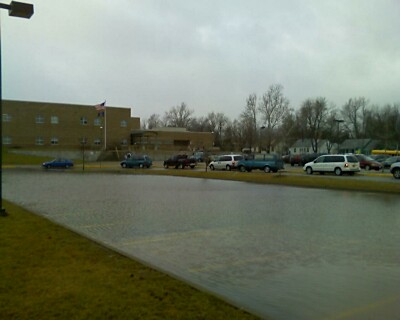
Yes, that is the parking lot to the elementary school. 4" deep in water. Nice bit of a storm we had overnight.
Friday, February 23, 2007

Saturday, February 10, 2007
History of NORAD Tracking Santa
CONELRAD: Atomic Culture | NORAD Tracks Santa [1964]: "The 'NORAD Tracks Santa' tradition goes back to the late 1950s when a young boy accidentally dialed the unlisted number of the Director of Combat Operations at NORAD Headquarters in Colorado Springs."
Now it's Weather Radar, but still facinating...
Now it's Weather Radar, but still facinating...
Friday, February 09, 2007
Internet Weather Forecast Accuracy
OmniNerd - Articles: Internet Weather Forecast Accuracy: "Weather forecasting is a secure and popular online presence, which is understandable. The weather affects most everyone's life, and the Internet can provide information on just about any location at any hour of the day or night. But how accurate is this information? How much can we trust it?"
Tuesday, January 30, 2007
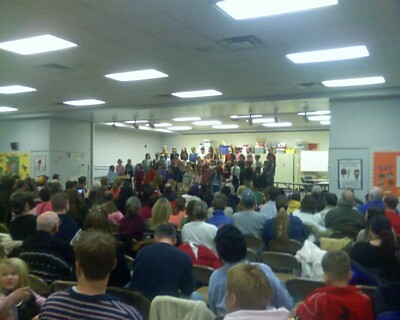
Alec in his first musical
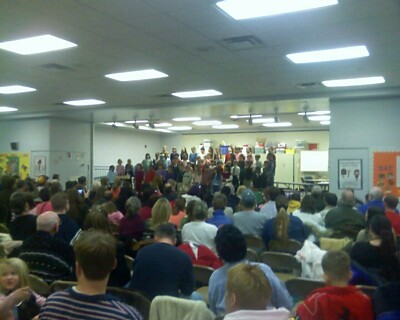
Way up there on the right is Alec. He did mighty fine in his first Kindergarten musical!
Sunday, January 28, 2007
WWII Homework..
If'n you're interested, my homework this week:
The Battle Of Britain was the first full scale air battle fought in modern war. Germany needed to gain air superiority over Britain before it could begin moving naval and ground troops in for attack. The battle was fought between the Royal Air Force and the German Luftwaffe between 10 July and 31 October. The Germans needed to destroy the RAF fighter forces. The goal for the RAF was to stop the bombers before they got to their targets, and to shoot down as many German aircraft as possible.
The Germans nearly won the fight - in late August, they were attacking the command airfields around London, and nearly wiped out the backbone of the RAF. However, for some reason, the Germans decided to switch targets, allowing the RAF to recover.
Beyond the significance in the face of the war, this battle was the first that used a combined command and control network blending fighter aircraft, radar and ground defenses into one unified force to stop the German attack. Before this, air defense had been an ad-hoc effort done by each station as the bombers passed over.
Propaganda is communication used to promote your ideals, or denigrate the ideals of another. It preys primarily on emotion, rather than reason, using inflammatory words, images, sounds and ideas. Propaganda can be used for good purposes - to instill a spirit of success and freedom, as in these posters:
Or to encourage greater production for a cause;
Or for less positive purposes:
For a full discussion of the techniques of Propaganda, refer to this website:
http://www.orange-papers.org/orange-propaganda.html
The Allies were not the only ones using propaganda - Hitler based his entire rule on "the big lie" - as he noted in Mein Kampf: "The greatness of the lie is always a certain factor in being believed; at the bottom of their hearts, the great masses of a people are more likely to be misled than to be consciously and deliberately bad, and in the primitive simplicity of their minds, they are more easily victimized by a large than by a small lie.... Some part of even the boldest lie is sure to stick." (Hitler, 1924)
You can further read his views on war propaganda from Mein Kampf at this website:
http://www.hitler.org/writings/Mein_Kampf/mkv1ch06.html
The single largest factor leading to the evacuation at Dunkirk was the surrender of Belgium on May 28, 1940. King Leopold III decided to end the fighting on Belgian territory. This freed up German forces to concentrate on the British Expeditionary Force. Because of this greater threat than anticiapted, the British Government decided to evacuate on May 28. Prior to this, the German Army had driven the French and British Expeditionary force back, but there was still hope. The Belgian army kept open the line of retreat to the sea for the French and British forces. When Leopold surrendered, he exposed a 30 mile wide hole for the Germans to exploit. Evacuation was the only option. The evacuation was covered under 'Operation Dynamo', where anyone with a boat was urged to help. Any description I put would pale beside the words of Churchill:
"[...]the Royal Navy, with the willing help of countless merchant seamen, strained every nerve to embark the British and Allied troops; 220 light warships and 650 other vessels were engaged. They had to operate upon the difficult coast, often in adverse weather, under an almost ceaseless hail of bombs and an increasing concentration of artillery fire. Nor were the seas, as I have said, themselves free from mines and torpedoes. It was in conditions such as these that our men carried on, with little or no rest, for days and nights on end, making trip after trip across the dangerous waters, bringing with them always men whom they had rescued. The numbers they have brought back are the measure of their devotion and their courage. The hospital ships, which brought off many thousands of British and French wounded, being so plainly marked were a special target for Nazi bombs; but the men and women on board them never faltered in their duty." (Churchill, 1940)
http://www.indiana.edu/~league/1940.htm
http://www.winstonchurchill.org/i4a/pages/index.cfm?pageid=393
http://www.time.com/time/magazine/article/0,9171,764003-2,00.html
http://www.time.com/time/magazine/article/0,9171,763997,00.html
The Maginot Line was built in order to allow a smaller force to take the offensive against the Germans. Originally conceived of by the French Minister of War, Andre Maginot, the purpose of the line was to provide a shrot-term defensive line against German attack, while a French counter attack cut off the German supply lines. The French wanted to envelop the German right flank by striking through Belgium from their own left. To do this, they had to hold the front line at Vosges with mobile units, comprising only a small part of the total force. This would give them enough men to make the counter attack. The Maginot Line was built to help in that defense - to hold the Germans back briefly while a massive counter attack took place through Belgium. However, when the Germans did attack, the French did not counter attack and only offered passive resistance (MacArthur, 1964). The Maginot Line was not designed to withstand the onslaught of the entire German army without any pressure elsewhere. Without the counterattack, the line failed.
MacArthur, Douglas. (1964). Reminiscences (p 107). New York, New York: Fawcette.
The Battle Of Britain was the first full scale air battle fought in modern war. Germany needed to gain air superiority over Britain before it could begin moving naval and ground troops in for attack. The battle was fought between the Royal Air Force and the German Luftwaffe between 10 July and 31 October. The Germans needed to destroy the RAF fighter forces. The goal for the RAF was to stop the bombers before they got to their targets, and to shoot down as many German aircraft as possible.
The Germans nearly won the fight - in late August, they were attacking the command airfields around London, and nearly wiped out the backbone of the RAF. However, for some reason, the Germans decided to switch targets, allowing the RAF to recover.
Beyond the significance in the face of the war, this battle was the first that used a combined command and control network blending fighter aircraft, radar and ground defenses into one unified force to stop the German attack. Before this, air defense had been an ad-hoc effort done by each station as the bombers passed over.
Propaganda is communication used to promote your ideals, or denigrate the ideals of another. It preys primarily on emotion, rather than reason, using inflammatory words, images, sounds and ideas. Propaganda can be used for good purposes - to instill a spirit of success and freedom, as in these posters:
Or to encourage greater production for a cause;
Or for less positive purposes:


For a full discussion of the techniques of Propaganda, refer to this website:
http://www.orange-papers.org/orange-propaganda.html
The Allies were not the only ones using propaganda - Hitler based his entire rule on "the big lie" - as he noted in Mein Kampf: "The greatness of the lie is always a certain factor in being believed; at the bottom of their hearts, the great masses of a people are more likely to be misled than to be consciously and deliberately bad, and in the primitive simplicity of their minds, they are more easily victimized by a large than by a small lie.... Some part of even the boldest lie is sure to stick." (Hitler, 1924)
You can further read his views on war propaganda from Mein Kampf at this website:
http://www.hitler.org/writings/Mein_Kampf/mkv1ch06.html
The single largest factor leading to the evacuation at Dunkirk was the surrender of Belgium on May 28, 1940. King Leopold III decided to end the fighting on Belgian territory. This freed up German forces to concentrate on the British Expeditionary Force. Because of this greater threat than anticiapted, the British Government decided to evacuate on May 28. Prior to this, the German Army had driven the French and British Expeditionary force back, but there was still hope. The Belgian army kept open the line of retreat to the sea for the French and British forces. When Leopold surrendered, he exposed a 30 mile wide hole for the Germans to exploit. Evacuation was the only option. The evacuation was covered under 'Operation Dynamo', where anyone with a boat was urged to help. Any description I put would pale beside the words of Churchill:
"[...]the Royal Navy, with the willing help of countless merchant seamen, strained every nerve to embark the British and Allied troops; 220 light warships and 650 other vessels were engaged. They had to operate upon the difficult coast, often in adverse weather, under an almost ceaseless hail of bombs and an increasing concentration of artillery fire. Nor were the seas, as I have said, themselves free from mines and torpedoes. It was in conditions such as these that our men carried on, with little or no rest, for days and nights on end, making trip after trip across the dangerous waters, bringing with them always men whom they had rescued. The numbers they have brought back are the measure of their devotion and their courage. The hospital ships, which brought off many thousands of British and French wounded, being so plainly marked were a special target for Nazi bombs; but the men and women on board them never faltered in their duty." (Churchill, 1940)
http://www.indiana.edu/~league/1940.htm
http://www.winstonchurchill.org/i4a/pages/index.cfm?pageid=393
http://www.time.com/time/magazine/article/0,9171,764003-2,00.html
http://www.time.com/time/magazine/article/0,9171,763997,00.html
The Maginot Line was built in order to allow a smaller force to take the offensive against the Germans. Originally conceived of by the French Minister of War, Andre Maginot, the purpose of the line was to provide a shrot-term defensive line against German attack, while a French counter attack cut off the German supply lines. The French wanted to envelop the German right flank by striking through Belgium from their own left. To do this, they had to hold the front line at Vosges with mobile units, comprising only a small part of the total force. This would give them enough men to make the counter attack. The Maginot Line was built to help in that defense - to hold the Germans back briefly while a massive counter attack took place through Belgium. However, when the Germans did attack, the French did not counter attack and only offered passive resistance (MacArthur, 1964). The Maginot Line was not designed to withstand the onslaught of the entire German army without any pressure elsewhere. Without the counterattack, the line failed.
MacArthur, Douglas. (1964). Reminiscences (p 107). New York, New York: Fawcette.
Subscribe to:
Posts (Atom)